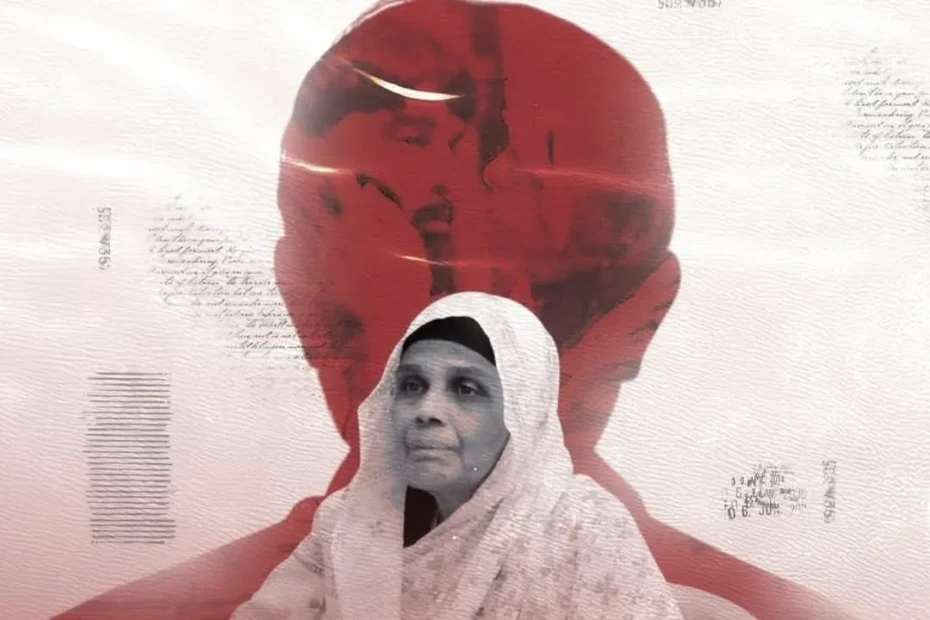
The years-long wait of an ailing, elderly mother from Kerala for the return of her young son—imprisoned for 17 long years—and the hope, memories, and enduring expectation kept alive within her frail, failing body…
“BEEYUMMA-JI,” too, like my mother, is bedridden due to serious illness and unable to move; she is eagerly waiting for her son’s return from jail—a wait that has lasted for Seventeen years.
A month has passed, since I spent some time with “BEEYUMMA-JI”—an elderly and ailing mother from Malappuram, Kerala—that meeting, remains fresh in my mind; It is something that cannot be easily forgotten… nor should it be.
The difficult phase “Beeyumma-ji” is going through reminded me of my own mother… about 16 years ago, my mother was in a very similar state, she was lying in bed, waiting for my return from jail. And who knows—from Delhi to Kerala, that is, across the entire country—how many mothers or sisters might be waiting to meet their children and loved ones.
Today, I have tried to remember “BEEYUMMA-JI” (and my own “Ammi-jaan”) through this article. I thank all those friends of mine who gave me the opportunity to meet Beeyumma-ji and extended their generous support.
Another mother lying in a bed, waiting a long time for her son.
That door no longer heralds an arrival with the familiar sounds of the past. Yet, she looks towards it every morning and evening—as if the door is about to open, and BEEYUMMA’s son ZAKARIYA will be standing right before her!
That old woman is now constantly ill; her body has gradually begun to fail her. The legs that once carried her as she bustled about the house are now unable to walk; her eyesight has grown dim, and her voice has lost its former strength. Yet, her eyes—filled with anticipation—remain clear.

Her young son ZAKARIYA has been an undertrial prisoner for 17 years and is still struggling to get justice. Even a convicted prisoner would have been released in such a long time!
For years, she has been waitin for his return. It is as if time has stood still! People say, “Give up hope now.” But how can a mother give up hope?
How can anyone convince someone—who raised a child in their arms, who spent a lifetime wiping the sweat from that child’s brow, and who saved morsels of food by suppressing their own hunger—to stop waiting for that child’s return?
A prison has a world of its own—a world of the deaf and the mute. There, the clock on the wall keeps ticking, sounds drift from the loudspeakers, and inmates in white move back and forth. In one cell, hope is born; in another, it is shattered.
But far away from the prison, the world of a sick mother lying helpless at home shrinks to nothing more than a bed and a single name.
To her, every piece of news from the prison feels like the beating of her own heart. For her, the prison is not merely a place; it is a vast, harsh, and exhausting distance standing between her and her son. Every time a phone rings, her heart suddenly races. Every time she hears a vehicle stop outside, she glances toward the door for a fleeting moment.
Sometimes she thinks—perhaps today he will come. Perhaps there will be a sudden knock at the door. Perhaps he will say, “Ma, I’m home.” And she, forgetting all her illness, will rise to her feet.
But the door does not open. A deep silence settles over the room once more. In that silence, there is the sound of her breathing, and in that breath, a name—her son—ZAKARIYA.
She has lost count of how much of her son’s life has slipped away while she waited outside the prison walls. The turning of calendar pages, the changing colors of the walls, the tree in the courtyard witnessing countless cycles of autumn and spring, the neighborhood children growing up, faces vanishing from the world, and festivals passing by without her son—recalling all of this is now just another source of deep anguish for her.
All she remembers is a time when her son was young and full of laughter, and his voice used to echo through the house. He would share little things with his mother—sometimes complaining, sometimes making her laugh, and at other times, simply coming over without a word to rest his head in her lap.
In a mother’s memories, her son remains exactly as he once was.
She can comprehend how the pain and helplessness of imprisonment must have altered his body and mind; yet, in her eyes, he is still that same child whose small hand once learned to walk while holding onto her finger.
Perhaps that is why the wait, however long, never truly ends.
Her years are slipping away, yet her maternal love for her son grows deeper with each passing day. Sometimes, lying in bed and gazing at the ceiling, she whispers to herself—
“Son, just come home now. Your mother won’t ask anything of you. She won’t complain, nor will she ask any questions. Just come and sit by my side for a while. And eat the food I’ve cooked for you.”
Perhaps she no longer has any great expectations of her son. She does not even want him to take away all her troubles. She simply wants to see his face. She wants to place her hand on his head. She wants to hear his voice just once.
For in some relationships, words are unnecessary; between a mother and son, a single glance can sometimes convey a lifetime of meaning.
She still keeps her son’s belongings carefully preserved at home. His old shirt, a few books. Perhaps an old toy or a scrap of paper with his handwriting on it.
A mother cannot bring herself to throw these things away, nor does she let anyone else touch them. For to her, these are not merely inanimate objects; they hold the touch of her son’s fingers, the echo of his voice, and the laughter of his childhood. Sometimes, she sits for a long while, holding his shirt in her hands. She seeks her son in the faint, lingering scent of the fabric. And then, her eyes fill up with tears. And perhaps, deep within, she asks—
“Why did you go so far away, son? When will you return?”
These questions are asked of no one. Not of the son.
Not of society. Not of the lawyers. Not of the judges.
It rises only within the mother—and is stifled right there.
When festivals arrive, the longing for him deepens. Aroma fills the homes, a variety of delicious and sweet dishes are prepared, and people visit one another. Somewhere, the laughter of children can be heard. But at her home, it is as if the festivals come right up to the doorstep only to turn back. She imagines taking out clothes for her son.
She wonders—What if he comes this time? Then, she answers herself—Perhaps next time.
This very “next time” is now the greatest anchor of her life.
Sometimes, forgetting her illness, she gazes at her son’s room. The room remains exactly as it was—As if her son had just walked in and stepped out a moment ago. She feels he is about to enter the room, scatter his things about, call out to her, and ask—”Ma, what have you cooked?”
And she would playfully scold him—”Go wash your hands and face first.”
Such a small wish.
Yet, some wishes are so small and big at the same time, that the entire world, even by coming together, cannot fulfill them!
Her body is now like a lamp slowly fading out. Yet, a tiny glimmer of light remains in that flame—the hope that perhaps her son might return. Her body, battling illness, is wracked with pain and helplessness, but the anguish in her heart is far greater. Doctors can treat her illness. Medicines can alleviate her suffering.
But who holds the cure for her son’s absence? What medicine can fill the void that has persisted within her for years? Sometimes, the night stretches on endlessly. Everyone in the house falls asleep. Silence descends upon the room. Lying in bed, a mother gazes at the ceiling. Sleep eludes her eyes. She thinks of her son.
For others, it is merely a period of waiting. For this mother, it is her very life!
And perhaps a mother’s greatest tragedy is this: her body may age, her eyes may grow weary, and her breath may slow—but her maternal love never grows old.
All she wants is for her son to return. She wants the prison gate to open and her son to stand before her. Upon seeing him, she might not be able to say a word. She might burst into tears. She might touch his face through her hands. Run her fingers through his hair.
And simply say, “My child is back…” In that single moment, her years of waiting would seem to melt away, all her grievances would wash away in tears, all her questions would fall silent.
And perhaps, cradling her son’s head against her chest, she would speak those same old words—“Go to sleep, my child… I am right here.”
But she keeps waiting. Every morning. Every evening. At every knock. At the ring of every phone. At the sound of every passing vehicle. In every face that, from a distance, resembles her son’s. She knows that time is no longer on her side. She knows her body is growing frail. She knows she may not have much time left. But a mother’s hope knows no mathematics. It does not count time. It does not count the years. It counts only one day—the day her son returns.
This is why she still stares at the door, remains consious of the slightest sound. She still prays for her son, day and night. And even now, the door to her home is never fully closed. Because she feels—The day my son returns, he shouldn’t have to knock it to enter. I want him to find the door always open for him!
“The very door upon which a mother’s eyes remain fixed” and never strays from the door. She keeps waiting. As long as there is breath, as long as there is memory, as long as her son’s name beats within her heart. And sometimes—perhaps even until the very last moment of death—She keeps expecting a voice from outside, “Mother… open the door, I’m home”
May God grant that mother (BEEYUMMA-JI) strength and relief – Aameen.
***
Mohd Aamir Khan, lives in Delhi, is a Human Rights activist associated with Karwan-e-Mohabbat and author of the book, Framed As a Terrorist: My 14-Year Struggle to Prove My Innocence.
Translated by Syed Rubeel Haider Zaidi.